Illustration student on a winning streak

Currently exhibiting her work at D&AD’s new blood, Illustration student Lorna Scobie has recently won the Digital award at the Macmillan prize and scooped 2nd place at the Penguin Design Awards 2012. Below is Lorna’s account of her prize winning:

In May I was awarded the Digital award at the Macmillan pize. (http://www.panmacmillan.com/macmillanprize)

It’s an award which celebrates the best new talent in the field of Children’s picture books, and this year was the first time they awarded the ‘Digital Award’. This is really exciting because it signifies that the children’s publishing industry truly is opening it’s doors to digital books, apps and the like, and also shows that they value the importance of digital books alongside traditional books. 

I won £1000 for this award, they took me and my tutor Jane out for dinner (!) and my work was exhibited at Foyles bookshop in London for a while.

 My book, ‘Bradley’, explored the theme of concealed and unrecognised talents. Bradley’s literal glow in the dark qualities go unnoticed until a darker threat begins to emerge. The story has been designed to work as both a traditional printed book with pages that glow when held under the covers, and as a digital book. The concept for the digital version is to utilise the ability of an iPad to sense light levels, and to respond accordingly to help reveal Bradley’s secret.

 In June I came 2nd in the Penguin Design Awards 2012. I entered the Puffin Prize, and designed the book cover for Grimm’s Fairy Tales ( http://www.penguin.co.uk/static/cs/uk/0/minisites/penguindesignaward/pda2012_lscobie.php )
This is a very prestigious award in the design industry, and it is open to students on any art & design course.  For this I won £350.

 The wolf is a recurring and prominent character within the tales of the Brothers Grimm, and so he became the focus of my cover. I wanted the wolf to interact with the book and so he is wrapped around it, grasping the cover with his claws, tempting children to read it if they dare.

I used woodcut to create my design, harking back to traditional methods of book illustration, and also referencing the iconic setting of many of Grimm’s Fairy Tales – the deep dark woods . . .

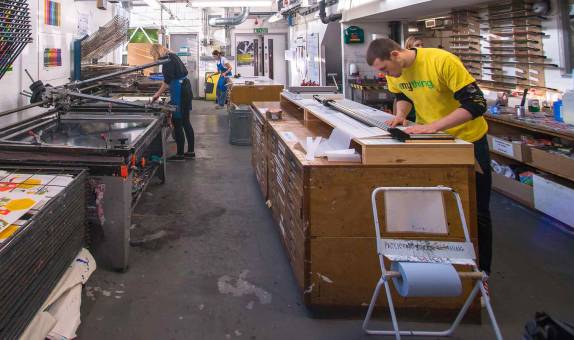
After hearing that I was shortlisted, and receiving feedback from Anna Billson, art director of Penguin Children’s, I enhanced my woodcut design by taking it through further print process. I used the facilities at uni to screenprint the cover in fluorescent red, and then embossed the wolf so he literally jumps out from the cover. Anna made a point of telling me that it was these processes that made me do well!

Smell in the City: presentation from Dr Victoria Henshaw

Design Research in the Faculty of Art, Design & Architecture:
Presentation from Dr Victoria Henshaw

Smell in the City
Knights Park Campus, Kingston University, Innoversity, Tuesday 10th July, 4pm

A researcher in architecture and urbanism at the University of Manchester, Victoria’s work examines the role of the senses in urban experience, perception and design, and specifically those relating to smell. It has featured in media across the world and the UK, including BBC Radio 4, The Independent and local broadcast and print media up and down the country.

Her talk will highlight the role that smell plays in everyday experiences and perceptions of the city, and tools that architects and urban designers might use when designing urban olfactory environments. The talk will draw from the findings of smellwalks’ Victoria has carried out in UK cities and overseas including Seattle, United States and Grasse in the South of France.

For more information please contact: Jane Harris (PhD, RCA) Professor of Design, Nesta Fellow: Faculty of Art, Design & Architecture Kingston University London, Knights Park Campus, Grange Rd, KT1 2QJ, tel: 07949 301 488; www.janeharris.org.uk

“Thanks, but no thanks” – designs in the dog house

Left on the shelf, unwanted and abandoned – two graphic design students from London’s Kingston University are helping homeless hounds at Battersea Dogs Home through a novel exhibition featuring rejected works of art.

 The exhibition, entitled Thanks But No Thanks, came about after Alex Brown and Ben West submitted a poster design for a competition. Although the pair were unsuccessful with their entry, it was this outcome that got the design duo thinking.

 “I was really pleased with the poster design we’d put together so had already decided that we would have it printed anyway,” Ben said. “It prompted us to think about the creative industry as a whole and how many artists and designers must have had similar experiences to us with their work perhaps being turned down or discarded when the designs weren’t quite right for the intended brief.”

 Handwriting more than 200 letters to graphic designers, the two students set about rounding up unwanted, unused and unfinished projects in the form of prints, paintings and posters. “It took a while to get all the pieces together,” Alex, 24, from Eastbourne, said. “We persevered though following up our letters with emails and phone calls and eventually the donations started coming in.”

 Once the artwork was in, Alex and Ben set up the exhibition at the Beach Gallery, London where it ran from June 1 – 6. Artwork on display ranged from a rejected poster for the 2014 Winter Olympics by Wally Olins to a hand lotion bottle by graphic design studio BOB Design that Space NK didn’t want. There was even something for music lovers in the form of an abandoned Bob Dylan portrait by graphic designer Ian Wright.

The show culminated in the donated designs being sold with the money going to Battersea Dogs Home. “The intention was always for the project to raise money for charity,” 23 year old Ben from Braunton in Devon, explained. “Donating the proceeds to Battersea Dogs Home made perfect sense as the artwork – just like the animals at the centre – had all been abandoned and rejected.”

The auctioned artwork raised a grand total of £700 for the pet charity. Bids ranging from £5 to £50 were placed for the individual pieces, with an unused illustration designed for Girl Talk magazine, donated by artist Rob Ryan, fetching the top price of £75. “There was no way of knowing how much money each piece was going to make,” Ben explained. “At the end of the day, it was all down to what people liked. Although Rob Ryan’s illustration wasn’t right for Girl Talk magazine, someone else loved it and just had to have it.”


Similarly, Alex was so taken with a piece donated by designer Marion Deuchars that he bought it himself. “I think one of the reasons I like it so much is because it’s hand drawn,” he said. “We were keen to receive items that showed the process and not just the finished, polished pieces.”

 More of Alex and Ben’s work will be on display at:

Take Shape
End of Year Show
5-9th July 2012
Dray Walk Gallery
The Old Truman Brewery
91 Brick Lane
London
E1 6QL


Graphic Design & Photography students make Channel 4 news

Two first year graphic design and photography students, Luke Evans and Josh Lake have been interviewed by Channel 4 news following their fascinating project called ’Inside Out’.  The students swallowed 35mm film to see the effect their digestive systems would have on it. The pair swallowed the individual frames of rolled up film in the dark in special canisters they had designed themselves. The canister had holes in it which allowed all the fluids, acids and enzymes in their stomachs to penetrate it and have their full effect on the film. The film was collected  in a dark room and then scanned using an electron microscope to see the damage their digestive systems had done to the surface of the film.

The resulting prints were exhibited at the Hoxton Gallery in London.


Jonathan Woolf receives RIBA Regional Award 2012


Jonathan Woolf who teaches studio in the School of Architecture and Landscape has received a RIBA Regional Award 2012 for his project  the Painted House.

RIBA Awards in the UK are for buildings by RIBA Chartered Architects and RIBA International Fellows. No matter the shape, size, budget or location, RIBA Award winning-schemes set the standard for great architecture all across the country.

For more inforamtion please visit:

http://www.architecture.com/RegionsAndInternational/UKNationsAndRegions/England/RIBALondon/Awards/RIBALondonAwards2012/PaintedHouse/PaintedHouse.aspx


Kingston lecturer to show at the Venice Architecture Biennale

David Knight, who teaches in Kingston’s School of Architecture and Landscape, has been inivited to show his ‘Folk in a Box’ project at the prestigious Venice Architecture Biennale.

Folk in a Box is the UK’s smallest performance venue. One audience member is allowed in at a time. The door is closed behind them. They are given one song, performed by one musician. By the time the song is the over, the musician is just about visible in the darkness and intimacy of the box. The experience is compelling.

In earlier incarnations, the Folk in a Box project has featured at Tate Britain, the Royal Festival Hall, and Battersea Arts Centre, plus a host of music festivals and street-corner appearances. The new box has been made ready for a tour of the UK later in 2012.

Funded by The Joyce Carr Doughty Trust with the support of BAC. Designed by David Knight & Cristina Monteiro for the Folk in a Box collective, including musicians Dom Coyote, Emily Barker and Pepe Belmonte. Built by Aldworth James & Bond. Photography by David Knight.

The 13th International Architecture Exhibition, directed by Kingston alumnus and hon doc David Chipperfield and titled Common Ground, will run in Venice from 29th August through 25th November 2012 (Preview on August 27th-28th). Deputy to David Chipperfield is Kieran Long who has also taught in the School of Architecture at Kingston.

Exclamation mark my words!

Over-worked. Misunderstood. Mocked by intellectuals. Such is the plight of the once-proud exclamation mark. Now a student at London’s Kingston University has come to the rescue of this much-maligned piece of punctuation, designing 12 new siblings to share its workload.

“The exclamation mark has become over used – and often comes across as crass,” 22 year old Benji Roebuck, from Huddersfield in West Yorkshire, said. “Part of the problem is that we’re asking one piece of punctuation to do too many jobs. So I’ve created a depression mark, a jealousy mark and even an excitement mark.”

Benji, who is studying graphic design at Kingston, got in touch with David Crystal, Honorary Professor of Linguistics at the University of Wales, Bangor – the author of more than 100 books about the English language and a regular contributor to television and radio programmes – asking him to set a brief.

“Most students go to designers for that type of thing but I wanted to do something a bit different,” Benji said. “I was surprised and really pleased when Professor Crystal replied suggesting I work on the exclamation mark. For a long time I didn’t know what to do, but found myself thinking about it more and more and realised I wasn’t going to be able to get it out of my head unless I did something about it.”

Some of the new range of exclamation marks are self-explanatory – anxiety is a squiggly line, while hope is indicated by an upwards arrow. Others are more oblique – a small question mark represents curiosity and a swollen exclamation mark conveys pride.

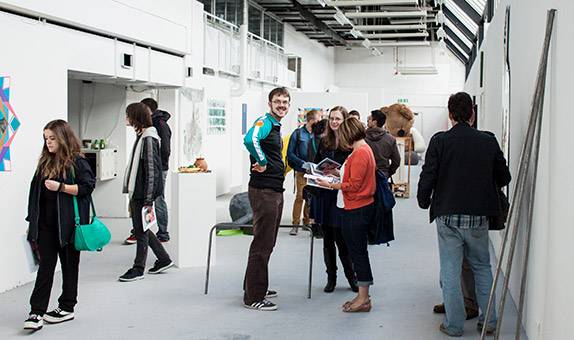
The results are currently on display at Kingston University’s Faculty of Art, Design and Architecture’s undergraduate degree show, which runs until June 22 at the Knights Park campus. They sit alongside final-year projects from a variety of disciplines including fashion, film-making, fine art, landscape architecture and product and furniture design.

Benji hopes show-goers will find his project thought provoking. “These exclamation marks would enable people to change the meaning of a sentence without altering any of the words,” he explained. Visitors to the exhibition will even be able to put the exclamation marks to the test and, using an ink pad provided, stamp it on to a sentence of their choice. “By applying a different exclamation mark they will be able to change the sense of what precedes it by indicating that the speaker is jealous, angry or confused,” he explained.

Benji has sent his finished designs to Professor Crystal, who has been impressed with the outcome. “Benji has produced a clever and innovative project, which makes one appreciate the limitations as well as the expressive potential of the punctuation system,” he said.

Kingston’s academic director of communication design, Rebecca Wright, said Benji had been fascinated by language and its importance to graphic designers during the course of his degree studies. “Benji is interested in the words, not just how they’re presented. In this project he’s had a great deal of fun experimenting with a punctuation mark – and visitors to the show will be able to share that enjoyment,” she added.

Students banish the mid-life blues and win RSA award

As pension ages rise, more and more employees are asking for a break from work 10 or 15 years before they retire. But how can their requests be accommodated without disrupting business?

That challenge has been taken up by two graphic design students from London’s Kingston University, who have devised a company called Mid Way to help people plan and save for a big career break – and even find someone to stand in for them at work. The creative students have designed an app for smartphones and tablet computers to help workers plan their sabbatical and have already impressed a panel of judges from the Royal Society of Arts, carrying off a prestigious Student Design Award.

“Our vision is that, at people’s first meeting with Mid Way, they’d be given the app,” Sophie Burt, 21, from Southampton, said. “It would help them calculate how much your career break would cost and work out ways of saving for it. The app would also include a logbook, in which they’d record everything they did at work on a daily basis so their replacement could see exactly what the job involved.”

The students developed the idea after asking people in their fifties about their plans and ambitions. ”We discovered that many of them wanted to go travelling,” Rachel Mintern, 22, from Stamford in Lincolnshire, said. “Their children had left home, they’d paid off their mortgage and they were still fit and healthy enough to have a real adventure. But their employers wouldn’t let them have more than two or three weeks off.”

The pair realised that protecting people’s job security was important. “People aged over 50 didn’t want to risk becoming out of work – they told us the employment market got less flexible as they got older and said it was harder to get back into it,” Sophie explained.

Rachel and Sophie have made a short film outlining the concept, which is being screened during the undergraduate degree show that runs until June 22 at Kingston University’s Faculty of Arts, Design and Architecture. In it, 50-somethings give their reactions to the Mid Way idea. “I think the experiences I would have while I was away would enhance what I had to offer when I came back,” interviewee Sian Allen says. “I think you’d come back re-energised, possibly feeling 10 years younger.”

Chief executive officer Neil Johnson is also featured in the film. “As an employer, I think it’s great to enable people to do that sort of thing,” he says. “They will be enormously appreciative of the business, and the business leaders, for letting them do it and keeping the job open.”

Rachel’s mother also makes a brief cameo appearance – riding on a donkey while on holiday in Morocco. “That was one of the things that helped get me thinking about the project – she’s always talking about how she loves to travel but, as the nurse in a GP practice, she can normally only get away for 10 days,” Rachel said. “The doctors can take a six-month sabbatical for educational purposes, but she can’t.”

One of Mid Way’s key roles would be to find the best possible replacement, who would shadow the person they were replacing for several weeks before the employee left. “One of the main challenges we faced was finding a way to reassure employers that their businesses wouldn’t suffer,” Sophie revealed. “Acting as a stand-in could look very good on the replacement worker’s CV. They could be an experienced person who has been desperately searching for an opportunity to break back into the job market or someone younger looking for experience,” Rachel added.

As well as coming up with the Mid Way concept, the students have produced a distinctive set of logos. The branding is based around a series of colour-coded hexagons, relating to the industries the individuals work in and what they plan to do during their break.

As part of their Royal Society of Arts award, Rachel and Sophie have won an internship with design and branding agency Dragon Rouge. “The jury was particularly impressed with Sophie and Rachel’s first-hand research and the fact that they uncovered the desire in people in middle age to travel while also maintaining job security,” Sevra Davis, of the RSA, said. “Sophie and Rachel’s well-developed business model and their thoughts about how the scheme could be adopted by employers lent further weight to their idea. In addition, their excellent graphic design skills made the idea and brand attractive from the start.”

Senior lecturer in graphic design at Kingston University Mike Bond was impressed, not just by the idea, but by the research the students had conducted to come up with it. “They uncovered a solution based on insight, derived from talking to real people and real businesses,” he said.

Deleuze for Artists: The Stanley Picker public lectures 2012

Image: Simon O’Sullivan 

The  Contemporary Art Research Centre, Kingston University presents the 2012 Stanley Picker Public Lectures on Art

DELEUZE FOR ARTISTS 
Tuesday 12 June, 6pm

A discussion held by Laura Cull and Simon O’Sullivan.

How might the critical concerns of Deleuze’s philosophy find common concern with art: to refuse representation and recognition; to bring about the most radical beginning which is also the most stubborn repetition? 

Laura Cull’s contribution will be in the form of a manifesto addressing a range of concerns relating to art practice including: authorship and collaboration, participation, the relationship between art and life, duration and temporality, and the role of animals in art, amongst others. The manifesto – drawn largely from her forthcoming book ‘Theatres of immanence: Deleuze and the ethics of performance’ (forthcoming Nov 2012, Palgrave) – will ventriloquize a range of figures alongside Deleuze including Allan Kaprow, Lygia Clark, Marcus Coates, John Cage, and Hijikata Tatsumi.

Simon O’Sullivan will give a presentation drawing on Deleuze and Guattari’s concept of a ‘Minor Literature’, addressing the ’future-orientation’ of contemporary art practice, and its capacity for ‘stuttering and stammering’ dominant codes and systems of communication.

This event takes place:

UPSTAIRS AT THE CRICKETERS
20 Fairfield South, KT1 2UL

FREE ENTRY

Facebook Event: https://www.facebook.com/events/440318765986795/


Ian Whittlesea: Mazdaznan Health & Breath Culture. Stanley Picker Gallery & Open Editions

Images of Kingston University Art & Design Foundation Course students performing Mazdaznan breathing exercises are being presented online and around the University as part of a project by the artist Ian Whittlesea, for the Stanley Picker Gallery’s off-site programme No Competition! exploring the relationship between art and non-competitive sport.

Swiss artist and teacher Johannes Itten famously led his Bauhaus students in a series of physical exercises before each day’s work. A devout follower of the teachings of Dr. Otoman Zar-Adusht Ha’nish, founder of the Mazdaznan religion, Itten would have based these exercises on Dr. Ha’nish’s 1902 instruction manual Mazdaznan Health & Breath Culture.

For No Competition! Whittlesea has produced a newly illustrated and annotated edition of Mazdaznan Health & Breath Culture featuring new drawings based on the photographs he took of the students. Co-commissioned with Open Editions London, the book will be launched at the Barbican Centre on 23 June from 2-3pm as part of the Bauhaus by Day/Bauhaus by Night programme of events accompanying the Barbican’s major summer exhibition Bauhaus: Art as Life.

Thanks to Christian Breidlid, Ezzidin Alwan and Helen McCathie for their invaluable photographic assistance, and to Rosie Brunning, Ivan Robirosa, Joey Phinn, Annabelle Syms, Harry Edwards, Amelia Butlin, Olivia Wills, Sophie Flanagan, Robert Hawkins, Ailis Brennan, Hamish Pearch, Jessica Dyer, Ruby Law, Molly Maher, Harvin Alert, Sophie Ray and Nettel Grellier who took part in the workshop to practice Mazdaznan exercises.

Visit www.stanleypickergallery.org to view the online project, and to find out more about the other commissions for No Competition! including a new video-work by Whittlesea as well as other projects by Paul Farrington and Charlie Murphy, all of which are being staged offsite and online whilst the Stanley Picker Gallery itself is closed for refurbishments.